Autism Basic Skills That Make Everyday Life Easier
Some days, it’s the “small skills” that cause the biggest stress – like getting dressed, finishing a worksheet, or knowing what comes next.
This page pulls together simple, autism-friendly basic skills ideas (plus trusted printables and tools) to support learning at home or in the classroom – without needing fancy setups.
Here’s what you’ll find below (all in one spot):
- Life skills checklists for chores and routines
- Visual supports (like “First, Then” boards and routine pictures)
- Math basics (skip counting, 100 charts, early times tables)
- Time & money foundations (practice sheets and tracking ideas)
- Fine motor + pre-writing practice
- Letters, numbers, colours, and sight words support
- Simple progress tracking sheets (so you can see growth)
How to use these resources
Pick ONE goal at a time and keep it simple:
- Make it visual (show the steps, don’t just say them). Visual schedules and “First, Then” supports can reduce anxiety and push-back around transitions.
- Break big tasks into small steps (this is called task analysis). It helps learners feel successful faster.
- Practice in short bursts, in different places (kitchen table, classroom desk, at the shops). Generalising is where real-life changes happen.
Your updated “Basic Skills” resource list
1) Self-Help Steps (chores + independence)
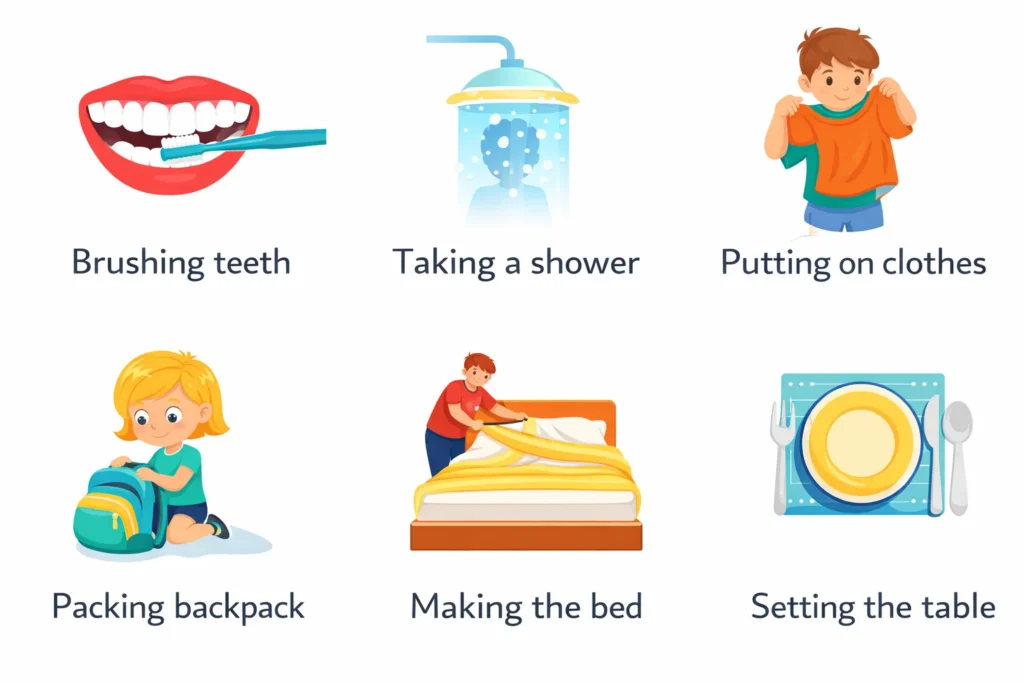
Use step-by-step routines and checklists for everyday tasks (bed making, tidying, kitchen jobs, laundry).
- Self-Help Steps – Not so much an ecological inventory as a data collection method for bed-making, house-keeping jobs, ironing, kitchen tasks, and laundry.
- Response Card A visual prompt and nonverbal response card to increase student choices and responses while they participate in daily classroom activities
- Printable chore/routine checklists (great for building independence).
- Visual supports toolkit with checklist examples (toilet routine, etc.).
2) Skip Counting Grids & Number Patterns
Perfect for oral practice, pointing, or quick “warm-ups”.
- Skip Counting Grid Sheets to practice in oral (or pointing) sessions. By Twos, by threes, by fives, by tens or download all Skip Counting Grids by 2’s,3’s,5’s, and 10’s
- Skip counting worksheets (2s, 3s, 5s, 10s and more).
3) Personal Information Forms (real-life safety skill)
Help learners practise: name, address, phone number (and what to do in an emergency).
- Personal Information Forms – learning how to fill out forms is a useful life skill. The prerequisites are reading and some memorisation of basic knowledge. Close students, but not quite up to this task, can be helped by a basic information booklet or fact sheet that a teacher can make up for them to use as a resource – also a useful skill. Print Common Knowledge Sheet #1, Sheet #2. Sheet #3. For variety, try it in a grid form and a choice of Favourites grid.
- General Knowledge Questions – to assess gaps
- “Knowing my address and telephone number” lesson pack ideas.
- Practice packs for phone number + address (extra activities).
4) Visual Supports (must-have for autism learning)
These are gold for transitions, behaviour support, and reducing stress.
- School Materials Communication board to help students with low verbal abilities make requests.
- Free “First, Then” board ideas + printable.
- Autism Queensland “First, Then” tips + printable resource.
- Victorian Department of Education visual resources (includes “Next/First-Then” style supports).
5) Fine Motor + Pre-Writing Skills
Short daily practice builds writing confidence.
- Free fine motor worksheets (tracing, mazes, cut & paste, pencil control).
6) Letters A–Z Printouts (with pictures to colour)
Great for letter recognition + vocabulary.
- Alphabet colouring pages (upper/lower case).
- Alphabet picture colouring pages (letter + matching pictures).
- A–Z letter practice worksheets (tracing/recognition).
7) Numbers Flashcards (1–20)
Use for matching, ordering, “find the number”, or quick games.
- Free 1–20 number cards (printable PDF).
- Simple 1–20 number flashcards (great classroom set).
8) Colours: Flashcards + Songs (fun = more repetition)
- Colour Songs – Download these PDFs to use in a morning circle/conversation group. Slip them into sheet protectors so they don’t get too grubby. They are usually popular with the younger set. The primary objective for students with autism should be selecting a song from the Choice Menu.
- Free colour flashcards (multiple formats).
- Free printable colour flashcards (another set, kid-friendly).
- Colour song to support learning (use gestures + real objects).
- Printable colour songs PDF (handy for group time).
9) 100 Grid & Missing Numbers
Good for number order, pattern spotting, and confidence with bigger numbers.
- Missing number charts 1–100 (free printables).
- Hundreds chart printables (desk reference / homework help).
10) Left & Right Concepts
Useful for handwriting direction, reading direction, PE, and daily instructions.
11) Sensory / Hands-On Addition
If worksheets cause stress, go hands-on first (then move to paper).
- A Sensory Approach to building a concept of Addition. Try worksheets one, two, three, and four or download all Sensory Addition worksheets
- Multisensory math activity ideas (build meaning before memorising).
12) Times Tables Practice (when ready)
Short, steady practice works best.
- Multiplication facts worksheets (lots of formats).

13) Simple Data Collection / Progress Tracking
Helps you track what’s improving (and what needs more practice).
- Simple Data Collection Sheets – to assess baseline knowledge. Use 2 sheets – one for the student to respond to randomly posed questions by pointing or circling answers, and one for you to quickly record results. Alternatively, use your favourite flash cards and use a sheet to record results. Test again, after instruction, to measure student progress.
Numbers 1-30, Upper Case Letters, Lower Case Letters, 10 Colours, 10 Colour Words, Days of the Week, Months of the Year, Shapes, and Dolch Pre-Primer Words. - Basic Assessment Pages to get a quick overview of new students and their grasp of basic information. This is a combined collection of the data sheets above.
- IEP-style progress monitoring sheet template.
- Practical guide to data collection sheets for special education.
- Data sheets for tracking IEP goals (useful templates).
14) Dolch Pre-Primer Sight Words
Helpful for early reading routines.